Intellectual property rights
Rights that protect the ideas, inventions and works people create, so nobody copies or uses them without the owner's permission. There are six kinds.
Page 32
Unit 2 · Lesson 2
7 steps. Each one is a short story and a question to answer.
Mariam designed a logo for her team, and a week later she found it on another company's product!
Intellectual property rights protect what people create: ideas, inventions and works.
They stop anyone from copying or using it without the owner's permission.
There are 6 types, each protecting something different.
Intellectual property protects...
Pick an answer
Rights that protect the ideas, inventions and works people create, so nobody copies or uses them without the owner's permission. There are six kinds.
Copyright starts automatically the moment you make the work, even if you never register it. Industrial property must be registered with the competent authority to be protected.
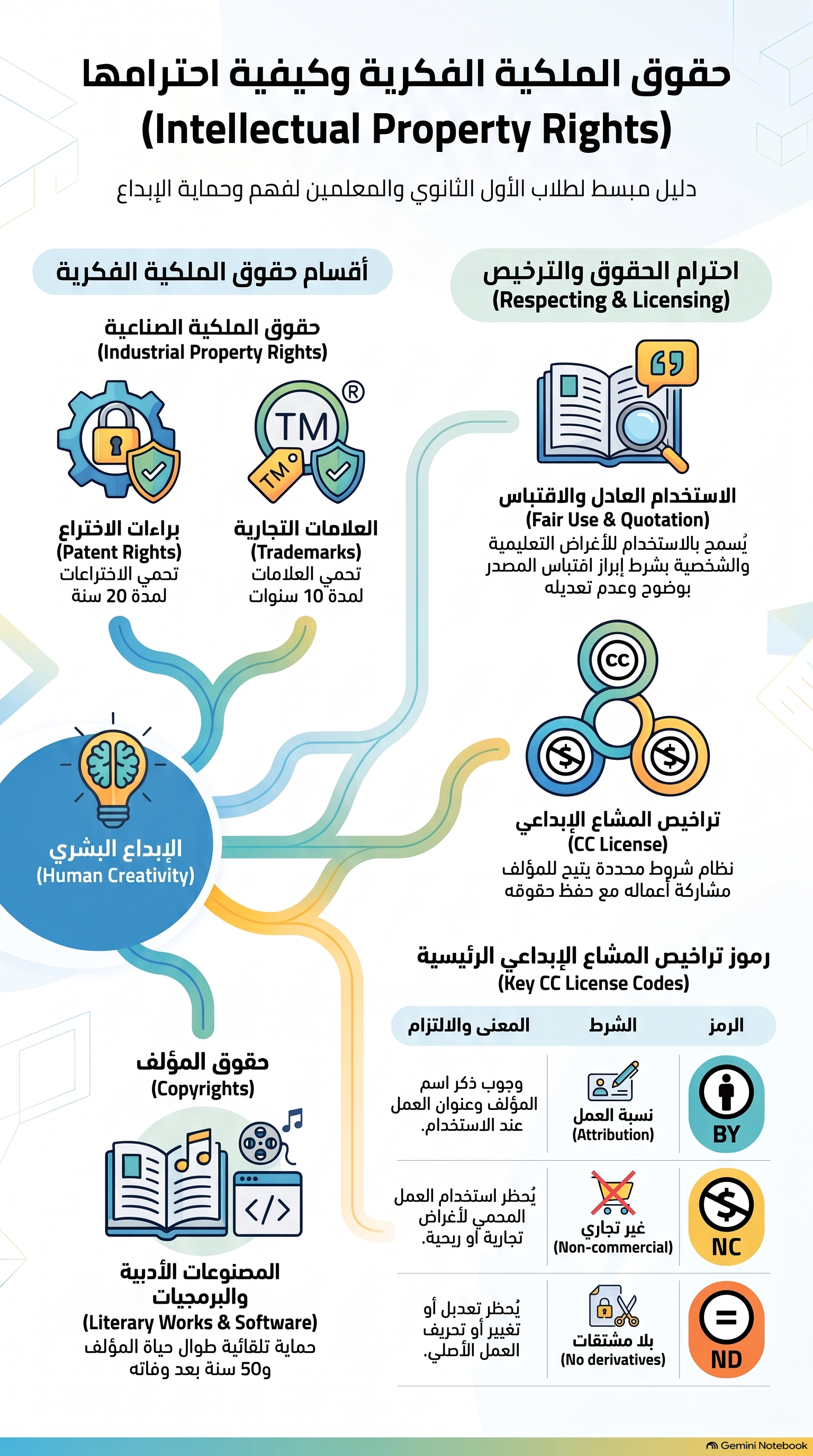
A patent lasts 20 years. A utility model lasts 7 years. An industrial design lasts 10 years. A trademark lasts 10 years and can be renewed.
Moral rights: the work is credited to you and you can object to any distortion of it. Financial rights: copying, distribution, translation, public performance and publishing to the public.
For those who bring a work to the public without being its author. A writer composes a song and owns the copyright. The singer, the record company and the station that broadcasts it hold neighboring rights.
The author's lifetime plus 50 years. If the author died in 2020, the rights stay protected until the end of 2070, and the heirs receive the financial rights.
Using a protected work without the owner's consent. You need permission before using a book, image, music clip, program or video. Illegally downloading music and films that are sold is infringement.
Scroll down ↓ to continue
Every idea in the lesson with its rule, ready to screenshot and revise from.
Intellectual property = protection for your creations against copying and unauthorized use
Copyright is automatic. Industrial property must be registered
Patent 20 years, utility model 7, designs 10, trademark 10 and renewable
Moral = credit and objecting to distortion. Financial = copying, distribution, translation, performance and publishing
Author = copyright. Whoever brings the work to the public = neighboring rights
Copyright lasts the author's life + 50 years after death
Using a protected work without the owner's permission = infringement
One question from every step. Answer and see your score.
Question 1 of 7
Intellectual property protects...
Unit 2
Learn the kinds of intellectual property rights, copyright versus industrial property, protection periods and copyright infringement, in a 3D explainer from the first-secondary book.
The same explanation as the 3D scene, written out for quick review.
Rights that protect the ideas, inventions and works people create, so nobody copies or uses them without the owner's permission. There are six kinds.
Page 32
Copyright starts automatically the moment you make the work, even if you never register it. Industrial property must be registered with the competent authority to be protected.
Page 32, 34
A patent lasts 20 years. A utility model lasts 7 years. An industrial design lasts 10 years. A trademark lasts 10 years and can be renewed.
Page 33
Moral rights: the work is credited to you and you can object to any distortion of it. Financial rights: copying, distribution, translation, public performance and publishing to the public.
Page 34
For those who bring a work to the public without being its author. A writer composes a song and owns the copyright. The singer, the record company and the station that broadcasts it hold neighboring rights.
Page 34, 35
The author's lifetime plus 50 years. If the author died in 2020, the rights stay protected until the end of 2070, and the heirs receive the financial rights.
Page 35
Using a protected work without the owner's consent. You need permission before using a book, image, music clip, program or video. Illegally downloading music and films that are sold is infringement.
Page 35