Data: facts with no meaning yet
Data is a set of facts. It can be numbers, letters or symbols, like 94, 2026, Ahmed and A. On its own it has no clear meaning, because it has not been organized yet.
Page 3
Unit 1 · Lesson 1
6 steps. Each one is a short story and a question to answer.
Imagine a message with only: 94, 2026, Ahmed and A. What do you learn from it? Nothing clear.
These are called data: a set of facts that can be numbers, letters or symbols.
On their own they have no clear meaning, because they are not organized yet. Who is Ahmed? What does 94 have to do with him?
Data is the raw material, like bricks before a house is built.
Which of these is raw data?
Pick an answer
Data is a set of facts. It can be numbers, letters or symbols, like 94, 2026, Ahmed and A. On its own it has no clear meaning, because it has not been organized yet.
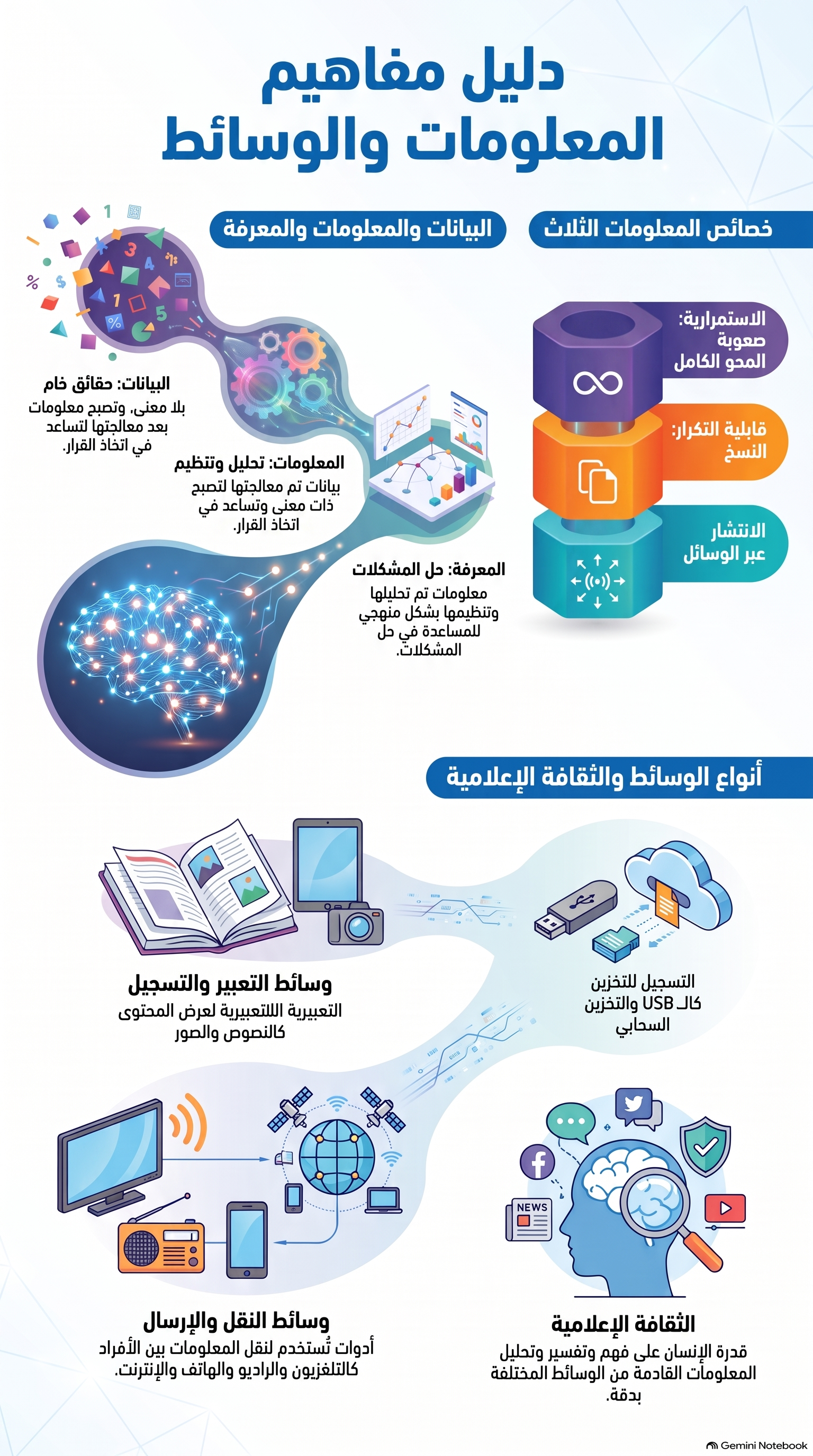
When data is organized or processed so it becomes useful and helps its receiver make a decision, it becomes information. Temperature readings gathered into a weather forecast are an example.
Knowledge is information that has been analyzed and organized systematically to help solve problems. When you know heavy rain is expected, you make a practical decision, like cancelling the trip.
Persistence: once information is created it is hard to erase completely. Reproducibility: it can be copied easily and in large quantities. Propagation: it spreads easily through mass media like newspapers, TV and the internet.
Media are the means or tools used to spread information and deliver it to people. Expressive media present the information, transmission media carry it, and storage media keep it.
It is a person's ability to understand, interpret and analyze information coming from TV, the internet or social media accurately. One of its tools is cross-checking: comparing information from several sources to confirm it.
Scroll down ↓ to continue
Every idea in the lesson with its rule, ready to screenshot and revise from.
Data = raw facts (numbers, letters or symbols) with no meaning on their own
Information = data that has been organized or processed and now means something that helps a decision
Knowledge = information analyzed and organized systematically to solve a problem
Persistence + reproducibility + propagation
Expressive = present, transmission = carry, storage = keep
Media literacy = understand, analyze and confirm information from more than one source
One question from every step. Answer and see your score.
Question 1 of 6
Which of these is raw data?
Unit 1
Learn the difference between data, information and knowledge, the three types of media, and media literacy, with a 3D explainer from the first-secondary book.
The same explanation as the 3D scene, written out for quick review.
Data is a set of facts. It can be numbers, letters or symbols, like 94, 2026, Ahmed and A. On its own it has no clear meaning, because it has not been organized yet.
Page 3
When data is organized or processed so it becomes useful and helps its receiver make a decision, it becomes information. Temperature readings gathered into a weather forecast are an example.
Page 3, 4
Knowledge is information that has been analyzed and organized systematically to help solve problems. When you know heavy rain is expected, you make a practical decision, like cancelling the trip.
Page 3, 4
Persistence: once information is created it is hard to erase completely. Reproducibility: it can be copied easily and in large quantities. Propagation: it spreads easily through mass media like newspapers, TV and the internet.
Page 3, 8
Media are the means or tools used to spread information and deliver it to people. Expressive media present the information, transmission media carry it, and storage media keep it.
Page 7, 8, 9
It is a person's ability to understand, interpret and analyze information coming from TV, the internet or social media accurately. One of its tools is cross-checking: comparing information from several sources to confirm it.
Page 5, 7, 8, 9